Intermittent Fasting vs. Regular Dieting: 99 Studies Reveal the Winner
The Simple Truth
Intermittent fasting (IF) has taken over the internet. Every fitness influencer swears by it. Your coworker won't shut up about their "eating window."
But does it actually work better than just eating less?
Researchers analyzed 99 clinical trials comparing intermittent fasting to continuous calorie restriction (regular dieting).
The results might surprise you.
What Is Intermittent Fasting?
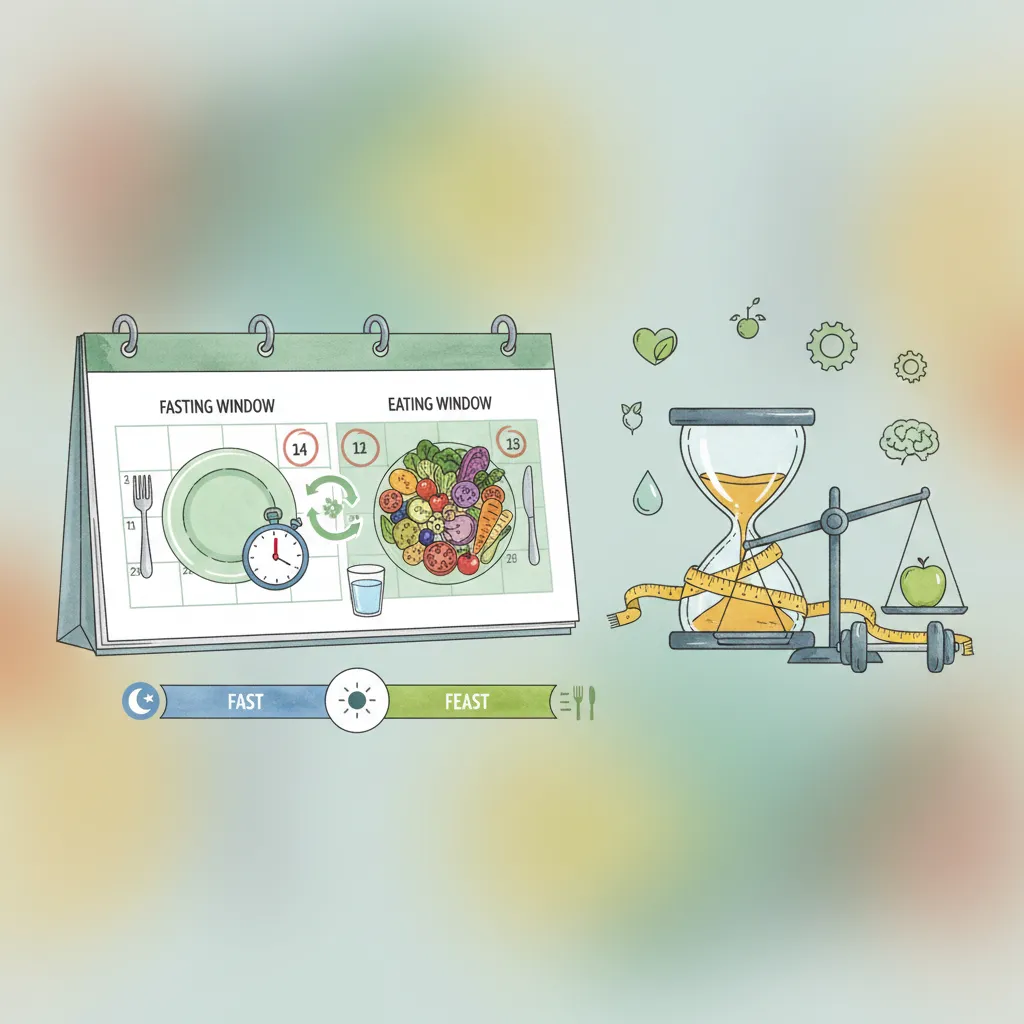
Intermittent fasting isn't about WHAT you eat. It's about WHEN you eat.
Common IF Protocols
🕐 16:8 Method (Most Popular)
- Fast: 16 hours
- Eat: 8-hour window
- Example: Eat 12pm-8pm, fast 8pm-12pm
📅 5:2 Diet
- 5 days: Eat normally
- 2 days: Eat only 500-600 calories
🔄 Alternate Day Fasting (ADF)
- Option 1: Fast every other day (zero calories)
- Option 2: Eat 25% of normal calories on "fast" days
🍽️ OMAD (One Meal A Day)
- Eat: One large meal per day
- Fast: The other 23 hours
The theory: Fasting periods lower insulin, increase fat burning, trigger autophagy (cellular cleanup), and make it easier to eat less overall.
What Is Regular Dieting (Continuous Calorie Restriction)?
You eat less every day. Simple.
- Maintenance: 2,500 calories
- Diet: 2,000 calories
- Every single day
No special timing. Just consistent calorie deficit.
The 99-Study Meta-Analysis: What They Found
A 2024 systematic review and meta-analysis examined 99 randomized controlled trials comparing IF to regular calorie restriction.
- Total participants: Over 8,000 adults across multiple countries
- Study duration: 4 weeks to 1 year
- Weight loss
- Fat loss
- Muscle loss
- Metabolic markers (insulin, blood sugar, cholesterol)
- Adherence (did people stick with it?)
- Side effects
Weight Loss: The Results
Average weight loss over 12 weeks:
| Diet Type | Weight Loss | Difference |
|---|---|---|
| Intermittent Fasting | -7.8 lbs (-3.5 kg) | 0.6 lbs |
| Regular Dieting | -7.2 lbs (-3.3 kg) | - |
Translation: They're basically the same.
When calories are matched, IF doesn't create extra fat loss.
Fat Loss vs. Muscle Loss
This is where it gets interesting.
Body Composition Changes
- Fat loss: 5.5 lbs
- Muscle loss: 2.3 lbs
- Fat-to-muscle loss ratio: 70/30
- Fat loss: 5.3 lbs
- Muscle loss: 1.9 lbs
- Fat-to-muscle loss ratio: 74/26
IF lost slightly more muscle. But the difference was small and not statistically significant in most studies.
Bottom line: Both preserve muscle reasonably well if you lift weights and eat enough protein.
Metabolic Benefits: Who Wins?
Here's how intermittent fasting (IF) compares to regular dieting across key metabolic markers:
📊 Insulin Sensitivity
| Approach | Improvement | Winner |
|---|---|---|
| Intermittent Fasting | 15-20% | ✓ Slight edge |
| Regular Dieting | 12-18% |
📊 Fasting Blood Glucose
| Approach | Reduction | Winner |
|---|---|---|
| Intermittent Fasting | -8 mg/dL | ≈ Tie |
| Regular Dieting | -6 mg/dL | ≈ Tie |
📊 LDL Cholesterol ("bad" cholesterol)
| Approach | Reduction | Winner |
|---|---|---|
| Intermittent Fasting | -10 mg/dL | |
| Regular Dieting | -12 mg/dL | ✓ Slight edge |
📊 Triglycerides
| Approach | Reduction | Winner |
|---|---|---|
| Intermittent Fasting | -15% | ✓ Slight edge |
| Regular Dieting | -12% |
📊 Blood Pressure
| Approach | Reduction |
|---|---|
| Both Methods | 5-8 mmHg systolic BP |
🎯 Overall Verdict: Metabolic improvements are nearly identical between IF and regular dieting. Any differences are too small to matter practically.
The Real Talk: It's About Calories
Here's what the research makes clear:
Intermittent fasting works because it helps people eat less, not because of metabolic magic.
How IF Reduces Calories
- Shorter eating window = fewer opportunities to eat
- Skipping breakfast = automatically 300-500 fewer calories
- Hard to overeat in 8 hours (but not impossible)
- Psychological: "I'm fasting" creates structure
But if you eat 2,500 calories in your 8-hour window, you won't lose weight.
And if you eat 1,800 calories spread across the whole day, you WILL lose weight.
It's always about total calories. Always.
Adherence: Which Diet Do People Actually Stick To?
This is the most important finding.
Dropout Rates (People Who Quit)
| Diet Type | Dropout Rate |
|---|---|
| Intermittent Fasting | 28-38% quit before study end |
| Regular Dieting | 22-32% quit before study end |
- Hunger in the morning
- Social difficulties (can't eat with family/friends)
- Fatigue, irritability
- Didn't fit their lifestyle
- Just hard to maintain long-term
- Constant restriction feels tedious
- Food tracking gets annoying
- Hunger throughout the day
- Lack of structure/rules
The best diet is the one you can stick to.
Who Should Try Intermittent Fasting?
IF works well if you:
✅ Naturally not hungry in the morning ✅ Like having clear rules and structure ✅ Prefer eating bigger meals vs. small frequent meals ✅ Have a consistent daily schedule ✅ Don't have social/family meals early in the day ✅ Don't do intense morning workouts ✅ Can handle hunger in the fasting window
IF might be better than regular dieting for you simply because you'll stick with it.
Who Should Skip Intermittent Fasting?
IF is NOT ideal if you:
❌ Get very hungry and irritable when you don't eat ❌ Have a history of disordered eating ❌ Are pregnant or breastfeeding ❌ Have diabetes or blood sugar issues (talk to doctor first) ❌ Do intense morning training (performance will suffer) ❌ Have family meals/social eating during your fast window ❌ Already struggle with binge eating
Warning: Fasting can trigger binge eating in susceptible people. The "break-fast" meal becomes a free-for-all.
The Autophagy Hype: Real or BS?
Autophagy = cellular "self-cleaning" process
The claim: Fasting triggers autophagy, which clears out damaged cells and proteins, leading to longevity and disease prevention.
The Reality
- Autophagy does increase with fasting (proven in animals)
- But you need 24-72 hours of fasting for significant autophagy
- 16-hour fasts show minimal autophagy benefits in humans
- Exercise also triggers autophagy (no fasting needed)
The studies on longevity and disease prevention are mostly in mice.
In humans, the benefits are theoretical and unproven for typical IF protocols (16:8, 5:2).
IF probably isn't extending your lifespan beyond what regular calorie restriction does.
Muscle Building and IF: Does It Work?
Can you build muscle while doing IF?
Yes, but it's harder.
Problems with IF for Muscle Gain
- Harder to eat enough calories in a short window
- Harder to get 4-6 protein feedings (optimal for muscle protein synthesis)
- Training fasted may reduce performance (less energy)
Research Shows
- Muscle growth is similar IF vs. regular eating if calories and protein are matched
- But practically, it's harder to hit protein targets in 8 hours
- Most bodybuilders/serious lifters don't do IF
If your goal is maximum muscle gain, regular eating (3-6 meals/day) is easier.
If you're just maintaining muscle while losing fat, IF is fine.
Does Meal Timing Matter?
Old belief: Eat 6 small meals to "stoke the metabolic fire" New belief: Meal timing doesn't matter, only total calories
What Science Actually Shows
- Eating late at night doesn't inherently make you fatter
- BUT: Most people who skip breakfast naturally eat less overall
- AND: Late-night eating often = snacking/overeating
- Adherence (what schedule helps YOU eat less)
- Performance (eating before workouts improves performance)
- Muscle building (spreading protein across day is slightly better)
- Metabolic rate
- Fat loss (if calories are equal)
The Hunger Problem
Does fasting reduce hunger over time?
The research says: Maybe.
First 1-2 Weeks of IF
- Hunger is HIGH during fasting window
- Irritability, fatigue, difficulty concentrating
- Ghrelin (hunger hormone) spikes at old meal times
After 2-4 Weeks
- Some people adapt: hunger decreases, energy improves
- Others never adapt: still miserable every morning
- Individual variation is HUGE
Ghrelin (Hunger Hormone) Findings
- Does decrease slightly after weeks of IF
- But not eliminated
- Some people stay hungry indefinitely
If you're absolutely starving every day after a month of IF, it's probably not for you.
Social Life and IF
This is where IF often fails in real life.
Scenarios That Break IF
- Breakfast meetings
- Brunch with friends (most IF = skip breakfast)
- Family dinners earlier than your window
- Happy hours before your eating window
- Travel (different time zones, unpredictable schedules)
- Changing windows daily defeats the purpose
- Inconsistency makes it harder to adapt
Regular dieting is more flexible socially: You can eat anytime, just keep portions controlled.
What About 5:2 or Alternate Day Fasting?
These are more extreme versions.
5:2 Diet (2 Days at 500-600 Calories)
- Slightly more fat loss than daily restriction (0.5-1 lb more over 12 weeks)
- But harder adherence (people often quit)
- Very low-calorie days are ROUGH
Alternate Day Fasting
- Similar or slightly worse adherence than 16:8
- No additional fat loss vs. regular dieting
- Dropout rates are HIGH (40%+)
More extreme ≠ better results.
The "Eat Whatever You Want" Myth
Biggest misconception about IF:
"I can eat whatever I want during my eating window and still lose weight!"
Nope.
If you eat 3,000 calories in 8 hours, you won't lose weight.
Studies Show
- People doing IF without tracking often eat 300-500 fewer calories naturally
- But some people compensate fully (eat more during window)
- Those who don't track and don't lose weight are eating at maintenance
You still need a calorie deficit. IF just makes it easier for SOME people to achieve that deficit.
IF for Different Goals
| Goal | Rating | Notes |
|---|---|---|
| Fat Loss | 7/10 | Works as well as regular dieting. Easier for some people to stick to. No metabolic advantage. |
| Muscle Gain | 5/10 | Possible but suboptimal. Harder to eat enough. Harder to spread protein intake. |
| Health/Longevity | 6/10 | Metabolic benefits similar to regular calorie restriction. Autophagy benefits overhyped. No proven longevity benefits in humans yet. |
| Convenience | 8/10 | Skipping breakfast saves time. Less meal prep. Simpler daily routine. |
| Athletic Performance | 4/10 | Training fasted reduces performance. Hard to fuel properly. Not used by most elite athletes. |
Practical Recommendations
Try IF If:
- You're not hungry in the morning anyway
- You like having clear rules and structure
- You prefer eating bigger meals vs. small frequent meals
- You have a consistent daily schedule
- You don't have social/family meals early in the day
- You don't do intense morning workouts
- You can handle hunger in the fasting window
Stick with Regular Dieting If:
- You wake up hungry
- You do morning workouts
- You have social/family meals throughout the day
- You're trying to build muscle
- IF makes you miserable
Either Way:
- Track your calories (at least initially)
- Eat 0.7-1g protein per lb body weight
- Lift weights 3-4x per week
- Be consistent for 8-12 weeks
The Bottom Line
After analyzing 99 studies:
Intermittent fasting and regular dieting produce essentially the same results when calories are matched.
| Metric | Result |
|---|---|
| Weight loss | Same |
| Fat loss | Same |
| Muscle preservation | Same |
| Metabolic benefits | Nearly identical |
| Adherence | Slightly worse for IF (more people quit) |
If it fits your lifestyle and you can stick to it, great. Use it.
If it makes you miserable, don't force it. Just eat less food.
The best diet is the one you can maintain long-term.
All roads lead to a calorie deficit. Pick the road that doesn't feel like torture.
References
- Cioffi, I., et al. (2024). "Intermittent versus continuous energy restriction on weight loss and cardiometabolic outcomes: a systematic review and meta-analysis of randomized controlled trials." Journal of Translational Medicine, 22, 204.
- Patikorn, C., et al. (2021). "Intermittent fasting and obesity-related health outcomes: an umbrella review of meta-analyses of randomized clinical trials." JAMA Network Open, 4(12), e2139558.
- Templeman, I., et al. (2021). "A randomized controlled trial to isolate the effects of fasting and energy restriction on weight loss and metabolic health in lean adults." Science Translational Medicine, 13(598), eabd8034.
- Lowe, D. A., et al. (2020). "Effects of time-restricted eating on weight loss and other metabolic parameters in women and men with overweight and obesity: the TREAT randomized clinical trial." JAMA Internal Medicine, 180(11), 1491-1499.
- de Cabo, R., & Mattson, M. P. (2019). "Effects of intermittent fasting on health, aging, and disease." New England Journal of Medicine, 381(26), 2541-2551.
- Seimon, R. V., et al. (2015). "Do intermittent diets provide physiological benefits over continuous diets for weight loss? A systematic review of clinical trials." Molecular and Cellular Endocrinology, 418(2), 153-162.
- Tinsley, G. M., & La Bounty, P. M. (2015). "Effects of intermittent fasting on body composition and clinical health markers in humans." Nutrition Reviews, 73(10), 661-674.
- Harvie, M. N., et al. (2011). "The effects of intermittent or continuous energy restriction on weight loss and metabolic disease risk markers: a randomized trial in young overweight women." International Journal of Obesity, 35(5), 714-727.
- Schübel, R., et al. (2018). "Effects of intermittent and continuous calorie restriction on body weight and metabolism over 50 wk: a randomized controlled trial." American Journal of Clinical Nutrition, 108(5), 933-945.
- Stekovic, S., et al. (2019). "Alternate day fasting improves physiological and molecular markers of aging in healthy, non-obese humans." Cell Metabolism, 30(3), 462-476.