Your Liver Burns Alcohol First: How Drinking Pauses Fat Loss
You track your food. You hit your steps. You're "basically good all week." Then Friday shows up with a few beers, Saturday brings wine with dinner, and somehow the scale hasn't moved in a month.
Here's the uncomfortable truth: alcohol doesn't just add calories. It jumps the queue. Your body treats it as something it has to get rid of first, and while it's busy doing that, fat burning gets put on hold. Then the drinks make you hungrier, wreck your sleep, and blunt your recovery from training.
None of this means one glass of wine ruins your life. It means you should know exactly what you're trading.
Alcohol Is the Fourth Macro, and It Has No Off Switch
Protein, carbs and fat are the macros everyone knows. Alcohol is the fourth, and it packs about 7 calories per gram, almost as much as fat (9) and well above protein and carbs (4).
Unlike the other three, your body has no way to store alcohol. It can't tuck it away in muscle like carbs or in fat cells like dietary fat. Alcohol (ethanol) is a toxin, so your liver treats clearing it as an emergency and moves it to the front of the line.
A standard US drink contains 14 grams of alcohol. That's roughly 100 calories from the alcohol alone, before you count any sugar or carbs in the drink.
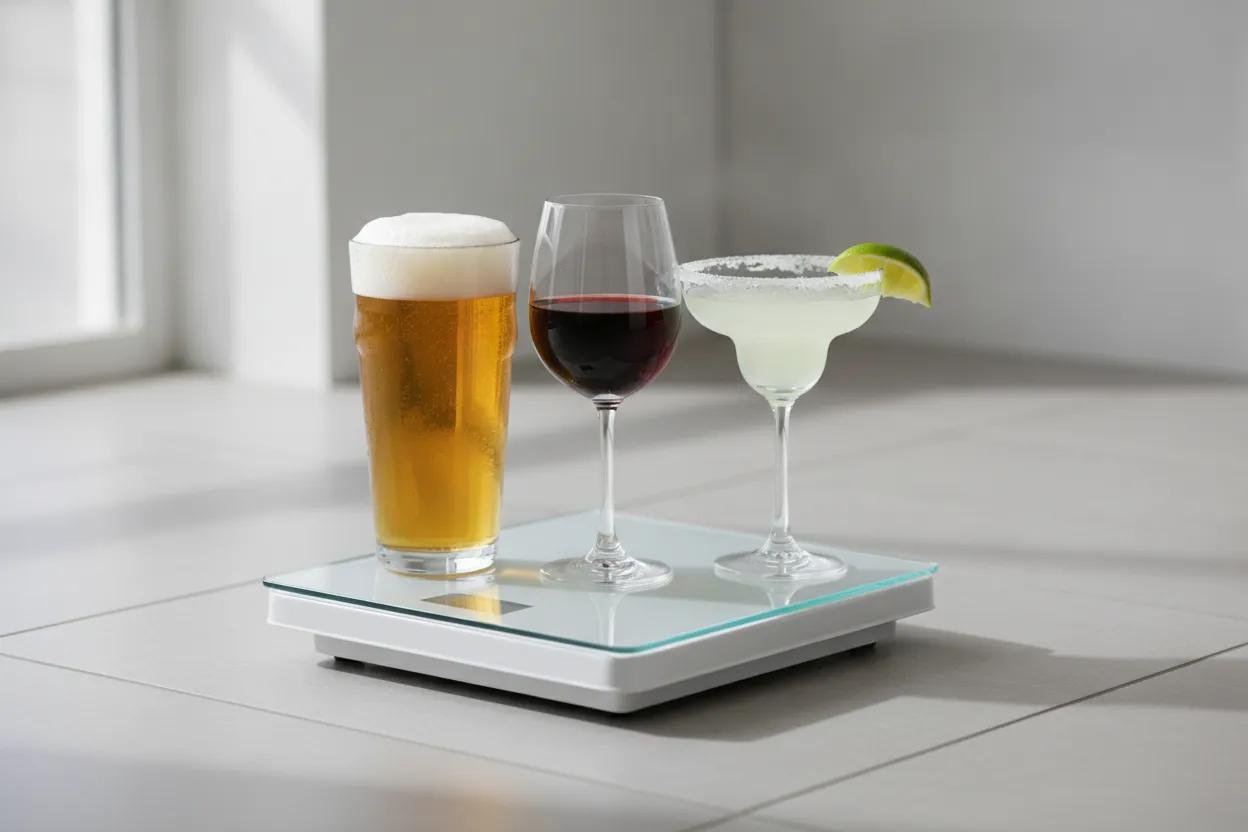
| Drink | Typical serving | Approx. calories |
|---|---|---|
| Light beer | 12 oz | 100–110 |
| Regular beer | 12 oz | 145–155 |
| Craft IPA (6.5–7%) | 16 oz pint | 250–300 |
| Red or white wine | 5 oz glass | 120–130 |
| Restaurant wine pour | 8–9 oz | 190–220 |
| Vodka, gin, whiskey | 1.5 oz shot | ~100 |
| Margarita or piña colada | 1 cocktail | 250–500 |
Notice the pours. A "glass of wine" at a restaurant is often closer to two standard drinks, and a pint of strong IPA can carry as many calories as a slice of pizza.
What Happens to Fat Burning When You Drink
The best direct evidence comes from a study at UC Berkeley published in the American Journal of Clinical Nutrition. Researchers gave healthy men 24 grams of alcohol, about two standard drinks, and tracked exactly what their bodies did with it over the next six hours.
The results:
- Whole-body fat burning dropped by 73% after drinking.
- Most of the alcohol, around three-quarters, was converted by the liver into acetate, which then flooded the bloodstream and became the body's preferred fuel.
- Very little alcohol, under 1 gram over six hours, was turned directly into new fat.
That last point matters, because it kills a popular myth. Alcohol isn't really "turning into fat." The problem is subtler: while your body burns acetate, it stops burning the fat you already have and the fat you just ate. That fat gets stored instead.
An earlier study in the New England Journal of Medicine found the same pattern over 24 hours in a sealed metabolic chamber. Whether alcohol was added on top of a normal diet or swapped in for other calories, people burned less fat, and more of the fat in their meals went into storage.
So the classic combo of beer and wings, or wine and a cheese board, is close to the worst case. The alcohol gets burned. The fat from the food gets saved for later, around your waist.
The "Apéritif Effect": Why You Eat More After a Few Drinks
If alcohol only added its own calories, you could just budget for it. But drinking also makes you eat more food.
A 2019 meta-analysis in the British Journal of Nutrition pooled 12 controlled studies. When people drank alcohol before or with a meal:
- They ate about 82 more calories of food than when they had a non-alcoholic drink.
- Counting the drink itself, their total intake went up by about 256 calories per sitting.
- People did not eat less to make up for the calories in the alcohol.
And that's in a lab, with measured portions. In real life, alcohol also shows up next to nachos, late-night drive-throughs and "we might as well get dessert."
Part of this happens in your brain. In a 2015 study published in Obesity, researchers gave women alcohol through an IV, which bypasses the stomach entirely. After the alcohol, their hypothalamus, a brain region that helps regulate appetite, reacted more strongly to the smell of food, and they ate more at the meal that followed. Alcohol turns up the volume on food cues, then lowers the willpower you'd use to ignore them.
Alcohol Wrecks the Sleep Your Diet Depends On
A nightcap might make you drowsy, but it makes the night worse.
A 2025 meta-analysis of 27 studies in Sleep Medicine Reviews found alcohol cuts REM sleep, even at low doses of around two drinks, and the more you drink, the more REM you lose. Higher doses can help you fall asleep a few minutes faster, but that's a terrible trade for the restorative sleep you give up later in the night.
That matters for fat loss. As we covered in One Bad Night's Sleep Rewires Your Brain for Junk Food Cravings, poor sleep pushes hunger hormones in the wrong direction and makes junk food look a lot more appealing the next day. Saturday night's drinks become Sunday's bagels, fries and "recovery" pizza.
Drinking Blunts Muscle Recovery, Too
If you're lifting while losing weight (and you should be), alcohol has one more cost.
In a 2014 study in PLOS One, active men drank a large amount of alcohol after a hard workout. Muscle protein synthesis, the process that repairs and builds muscle, fell by 24% even when they also had protein, and by 37% when they had alcohol with carbs instead.
To be fair, the dose was heavy, roughly a dozen drinks for an average man. Two beers won't erase your workout. But a big night out right after training clearly undermines the work you just did, and muscle is what keeps your metabolism up while you diet.
The Weekend Math That Erases Your Week
Here's how it plays out for a lot of people:
- Monday to Thursday: a disciplined 500-calorie daily deficit. That's 2,000 calories banked.
- Friday night: four craft beers at about 250 each is 1,000 calories, plus the extra food that comes with drinking.
- Saturday: three big restaurant pours of wine (about 600 calories), a heavier dinner than planned, and a late-night snack.
- Sunday: poor sleep, bigger cravings, a lazy day with fewer steps.
Add it up and that "good" week can finish close to break-even. You did nothing dramatic. You just drank like a normal adult on a weekend, and the deficit disappeared.
This is why your calorie target only works if you count everything. If you haven't worked out your real numbers yet, our calculator gives you your BMR, TDEE and daily calorie target. Use them, and count drinks like food.
Does This Mean Drinking Makes You Fat?
Not automatically. The research on moderate drinking and body weight is genuinely mixed. A 2024 National Academies review concluded there wasn't enough evidence to draw strong conclusions about moderate drinking (up to one drink a day for women and two for men) and weight change.
The picture changes with heavier drinking:
- In a study of nearly 8,000 young adults, published in the American Journal of Preventive Medicine, those who regularly binge-drank (4+ drinks for women or 5+ for men in one sitting, at least monthly) were 41% more likely to move from normal weight to overweight and 36% more likely to move from overweight to obese over five years.
- In the large Look AHEAD trial of adults with type 2 diabetes in an intensive weight-loss program, everyone lost similar amounts in the first year. By year four, non-drinkers had kept off 5.1% of their starting weight versus just 2.4% for heavy drinkers.
The pattern: an occasional drink fits fine into a fat-loss plan. Regular heavy or binge drinking makes losing weight, and keeping it off, a lot harder.
How to Drink Without Torching Your Progress
You don't have to quit to make progress. You do have to stop pretending drinks are free.
- Count every drink. Log it like food. If it's not in the tracker, you're guessing.
- Set a weekly cap. Pick a number of drinks per week in advance. Deciding at the bar never works.
- Choose lower-calorie options. Light beer, a standard 5 oz pour of dry wine, or a spirit with soda water and lime instead of sugary mixers and big IPAs.
- Alternate with water. One glass of water between drinks slows you down and cuts the total.
- Eat protein before you drink. A protein-rich meal beforehand helps blunt the "I'll just get fries" moment later.
- Keep fatty food away from the drinks. Since alcohol pauses fat burning, wings, cheese boards and fried snacks while drinking are the worst possible pairing.
- Don't drink right after training. Give your muscles a few hours, and eat protein first.
- Stop two to three hours before bed. You'll keep more of your REM sleep and wake up with fewer cravings.
- Plan the next day. Have breakfast and a walk lined up so one night doesn't turn into a lost weekend.
The No-BS Takeaway
Alcohol doesn't magically turn into fat, but it gets burned first. In the lab, about two drinks cut whole-body fat burning by 73%, while the fat from your food gets stored instead. On top of that, drinking adds calories you probably aren't counting, makes you eat more, wrecks your REM sleep and blunts muscle recovery.
An occasional drink can fit into a fat-loss plan. A weekly habit of heavy weekends quietly erases the deficit you worked for all week. Count it, cap it, and stop wondering why the scale isn't moving.
If you're worried about your drinking, talk to your doctor or call the SAMHSA National Helpline at 1-800-662-4357 (free, confidential, 24/7).
Scientific References
- Siler SQ, Neese RA, Hellerstein MK. De novo lipogenesis, lipid kinetics, and whole-body lipid balances in humans after acute alcohol consumption. American Journal of Clinical Nutrition. 1999;70(5):928–936.
- Suter PM, Schutz Y, Jéquier E. The effect of ethanol on fat storage in healthy subjects. New England Journal of Medicine. 1992;326(15):983–987.
- Kwok A, Dordevic AL, Paton G, Page MJ, Truby H. Effect of alcohol consumption on food energy intake: a systematic review and meta-analysis. British Journal of Nutrition. 2019;121(5):481–495.
- Eiler WJA, et al. The apéritif effect: Alcohol's effects on the brain's response to food aromas in women. Obesity. 2015;23(7):1386–1393.
- Gardiner C, Weakley J, et al. The effect of alcohol on subsequent sleep in healthy adults: A systematic review and meta-analysis. Sleep Medicine Reviews. 2025.
- Parr EB, Camera DM, Areta JL, et al. Alcohol ingestion impairs maximal post-exercise rates of myofibrillar protein synthesis following a single bout of concurrent training. PLOS One. 2014;9(2):e88384.
- Fazzino TL, et al. Heavy drinking in young adulthood increases risk of transitioning to obesity. American Journal of Preventive Medicine. 2017.
- Chao AM, Wadden TA, et al. Alcohol intake and weight loss during intensive lifestyle intervention for adults with overweight or obesity and diabetes. Obesity. 2019;27(1).
- National Academies of Sciences, Engineering, and Medicine. Review of Evidence on Alcohol and Health. Washington, DC: The National Academies Press; 2024.
- Nielsen SJ, Kit BK, Fakhouri T, Ogden CL. Calories consumed from alcoholic beverages by U.S. adults, 2007–2010. NCHS Data Brief No. 110. 2012.